Overview
Nepal packs an unusual range of landscapes into a short distance. In a single trip you can wander temple courtyards in the Kathmandu Valley, paddle across a lake in Pokhara with the Annapurna range reflected in the water, look for rhinos from a jeep in the lowland jungle of Chitwan, and then fly into the high mountains to walk for days between teahouses.
Most visitors arrive at Tribhuvan International Airport in Kathmandu. Pokhara and Bhairahawa (for Lumbini) also have international airports, although the bulk of long-haul traffic still runs through Kathmandu. Getting around is by domestic flight, tourist bus or private car, and distances that look small on a map can take a full day on mountain roads. Build slack into your plans.
Best time to go
The two classic seasons are autumn (October to November) and spring (March to May). Autumn usually brings the clearest mountain views after the monsoon has washed the air; spring is a little hazier but warmer, and rhododendron forests bloom on the mid-level trails. The Nepal Tourism Board lists the same two windows as best for the Everest region.
Winter (December to February) is dry and quiet with cold nights; lower treks and the cities are pleasant, while high passes may be snowbound. Monsoon (June to September) brings heavy rain, leeches on forest trails, cloud over the peaks and more flight disruption, but also green terraces, fewer visitors and good conditions in rain-shadow areas such as Upper Mustang.
Top places in Nepal
Kathmandu Valley
Three former royal cities, Kathmandu, Patan and Bhaktapur, each with a Durbar Square of pagoda temples and palaces. Add the great stupa at Boudhanath, the hilltop Swayambhunath and the riverside temple complex of Pashupatinath. The valley's monument zones are a UNESCO World Heritage Site. Entrance fees apply at most sites.
Pokhara
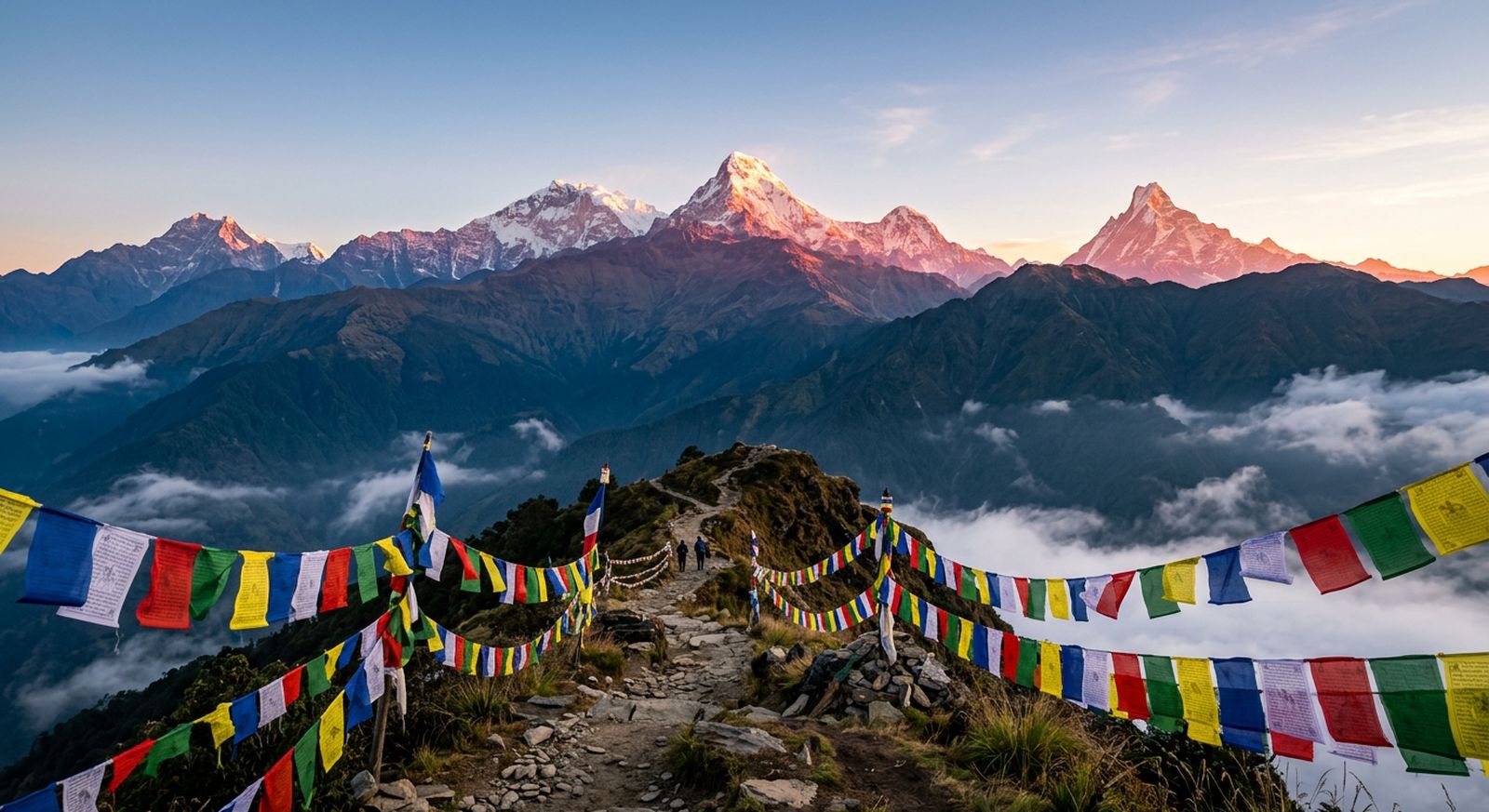
A relaxed lakeside town and the gateway to the Annapurna region. Go boating on Phewa Lake, catch sunrise over the Annapurnas and Machhapuchhre from Sarangkot, or try paragliding. It is also the natural place to rest after a trek.
Chitwan National Park
Subtropical forest and grassland in the southern lowlands, home to one-horned rhinoceros, gharial crocodiles, many bird species and a small number of tigers. Jeep safaris, guided jungle walks and canoe trips start from the villages on the park edge. Chitwan is a UNESCO natural World Heritage Site.
Lumbini
The birthplace of Siddhartha Gautama, the Buddha, and a UNESCO World Heritage Site. The sacred garden around the Maya Devi Temple is surrounded by a long development zone of monasteries built by Buddhist communities from many countries. Easiest access is via Bhairahawa.
Everest region (Khumbu)
Sherpa villages, monasteries and the trail to Everest Base Camp inside Sagarmatha National Park, another natural World Heritage Site. Most trekkers fly to Lukla; the Nepal Tourism Board puts the flight at about 30 minutes from Kathmandu.
Annapurna region
The most varied trekking area in the country: short lodge treks like Poon Hill, the walk into the Annapurna Sanctuary, and the long Annapurna Circuit over the Thorong La pass. Starting points are a few hours' drive from Pokhara.
Nagarkot and Dhulikhel
Hill stations on the valley rim, popular for a night away from the city with sunrise views of the Himalaya on clear mornings.
The big treks: Everest Base Camp and Annapurna
Everest Base Camp (EBC)
The classic route starts with a mountain flight to Lukla and follows the Dudh Koshi valley up through Namche Bazaar, Tengboche and Dingboche to Gorak Shep and base camp, at roughly 5,300 m. Many trekkers also climb the viewpoint of Kala Patthar for a closer look at Everest itself. Expect around two weeks return including acclimatisation days; the altitude, not the distance, sets the pace.
- Permits: Sagarmatha National Park entry plus a local municipality fee collected in the Khumbu. See the permit section below.
- Guide rule: the Nepal Tourism Board lists Everest Base Camp among the routes where trekkers must be accompanied by a licensed guide and carry an agency-issued TIMS card.
- Flights: Lukla flights are weather-dependent and delays of a day or more are common, so leave buffer days before your international flight home. In busy seasons some Lukla flights have operated from Ramechhap (Manthali), a long drive from Kathmandu; check with your agency.
Annapurna treks
The Annapurna Conservation Area offers several classic options. Poon Hill is a short teahouse loop with a famous sunrise viewpoint, good for a first trek. The Annapurna Base Camp (ABC, also called Annapurna Sanctuary) trek climbs through forest and Gurung villages into a ring of high peaks. The Annapurna Circuit is a longer journey through changing climate zones that crosses the Thorong La pass at more than 5,400 m; roads now reach parts of the route, so many trekkers skip the drivable stretches by jeep.
- Permits: Annapurna Conservation Area Permit (ACAP) plus a TIMS card.
- Guide rule: the Nepal Tourism Board lists the Annapurna Circuit, Poon Hill-ABC and Mardi Himal among the routes requiring a licensed guide and agency-issued TIMS card.
Altitude and safety
Ascend slowly, build in rest days, drink plenty of water and learn the symptoms of acute mountain sickness before you go. The only reliable cure for worsening symptoms is to descend. Buy travel insurance that explicitly covers trekking at the altitude you plan to reach and helicopter evacuation; many standard policies stop at a lower altitude. The Nepal Tourism Board publishes mountain safety advice.
Trekking permits and park fees (official figures)
Fees below are for foreign nationals from outside South Asia and were taken from official Nepalese sources on 28 October 2026. Rules and amounts change, sometimes at short notice, so confirm with the issuing office or your trekking agency before you travel.
| Permit | Where it applies | Official fee (foreigners) | Source |
|---|---|---|---|
| TIMS card | General trekking areas; on the listed guide-required routes it is issued through a registered agency | NPR 2,000 (SAARC nationals NPR 1,000) | Nepal Tourism Board: TIMS |
| Annapurna Conservation Area Permit (ACAP) | Poon Hill, ABC, Annapurna Circuit, Mardi Himal and more | NPR 3,000 per entry (SAARC NPR 1,000); children under 10 free | NTB park fees, NTNC e-permit |
| Sagarmatha National Park entry | Everest region | NPR 3,000 per entry (SAARC NPR 1,500); children under 10 free | NTB park fees |
| Khumbu Pasang Lhamu Rural Municipality fee | Everest region, collected locally | Set by the municipality; check the current amount locally or with your agency | Local government |
| Chitwan National Park entry | Chitwan safaris and walks | NPR 2,000 per entry (SAARC NPR 1,000) | NTB park fees |
| Restricted-area permit, e.g. Upper Mustang, Upper Dolpa | Special zones, issued by the Department of Immigration via an agency | USD 50 per person per day (Upper Mustang and Upper Dolpa) | NTB trekking permits |
Some counters add VAT or a service charge on top of the base fee. The NTNC online permit system adds a payment gateway charge for card payments and states that permits are non-refundable and non-transferable. Park entry fees can be paid at the Tourist Service Center in Bhrikutimandap, Kathmandu, or at park entry points.
Getting there
There are no direct flights from Scandinavia, so most travellers connect once via a Gulf hub (Doha, Dubai, Abu Dhabi), Istanbul or Delhi. From Southeast Asia, Bangkok and Kuala Lumpur have direct services. Compare one-stop itineraries carefully: layover length and baggage rules matter more on this route than a small fare difference.
For domestic legs (Pokhara, Bharatpur for Chitwan, Bhairahawa for Lumbini, Lukla), book once you know your trekking dates and keep plans flexible: mountain flights depend on visibility.
Tap a route to see live fares from our flight partner. We never show made-up prices.
Where to stay
Compare hotels, guesthouses and apartments with our accommodation partner. Check the total price including taxes, and the cancellation terms, before you book.
Tours & activities
Day trips, guided walks, tickets and multi-day tours from established activity marketplaces. Read recent reviews and check what is included.
Visa & entry
Nepal issues tourist visas on arrival at Tribhuvan International Airport (Kathmandu) and other official entry points, including Pokhara and Gautam Buddha international airports, according to the Nepal Tourism Board. You can fill in the online application before you fly; the Department of Immigration says the printed submission receipt is valid for 15 days. Citizens of India do not need a visa, and nationals of a small number of countries are not eligible for a visa on arrival.
Official on-arrival fees, all multiple entry, as published by the Department of Immigration: 15 days US$30, 30 days US$50, 90 days US$125. Extensions are handled by the Department of Immigration in Kathmandu or Pokhara, with a total limit of 150 days per visa year. Your passport should be valid for at least six months. Carry some cash in US dollars or another major currency in case card payment is not available.
Official sources:
Budget tips
- Teahouse trekking can be very good value, but costs climb with altitude: every item is carried up by porters or animals. Budget extra for hot showers, charging and Wi-Fi on the trail.
- Carry enough Nepalese rupees before you leave Kathmandu or Pokhara. ATMs are scarce on most trails.
- Book a licensed guide through a government-registered agency; on many popular routes it is now required anyway, and a good guide improves safety and the experience.
- Kathmandu's Thamel and Pokhara's Lakeside have the widest range of budget and mid-range rooms. Booking the first night before you land saves a tired search.
- Travel in spring or autumn shoulder weeks (early March, late November) for quieter trails and more room availability.
Before you go
- Travel insurance that covers trekking at altitude and helicopter evacuation.
- An eSIM for mobile data from the moment you land.
- A pre-booked airport transfer for a late arrival.
- Car rental and hotel search.
Frequently asked questions
Do I need a visa for Nepal?
Most foreign visitors need a tourist visa, which can be obtained on arrival at Kathmandu airport and other official entry points. Indian citizens do not need a visa. Official fees in October 2026 were US$30 for 15 days, US$50 for 30 days and US$125 for 90 days. Check the Department of Immigration website before travel.
Can I trek to Everest Base Camp without a guide?
Since the revised TIMS provision of 31 March 2023, the Nepal Tourism Board lists Everest Base Camp among the routes where trekkers must be accompanied by a licensed guide and carry an agency-issued TIMS card. Confirm the current rules with a registered agency.
What permits do I need for the Annapurna Base Camp trek?
An Annapurna Conservation Area Permit (ACAP, NPR 3,000 for foreigners per the Nepal Tourism Board) and a TIMS card (NPR 2,000). The route is on the guide-required list.
When is the best time to visit Nepal?
October to November and March to May are the main seasons, with the clearest mountain views usually in autumn. Monsoon runs from about June to September.
Some links on this page are affiliate links: if you book through them we may earn a commission, at no extra cost to you. Partner names and trademarks belong to their owners. How we make money.